

AI adoption in marketing is no longer the interesting part of the story.
According to Salesforce’s 2026 State of Marketing research, 75% of marketers are already using AI. Yet 84% still say they run generic campaigns, while 98% report hitting barriers to personalisation.
That gap caught our attention.
Marketers have more AI at their disposal than ever, but much of it still struggles with the thing good marketing depends on: Context.
It is also a big part of why we built Saai.
Saai is the AI marketing expert inside the Solitics platform. She works with the customer data and marketing environment already connected to Solitics, helping marketers understand what is happening and turn that understanding into action.
The findings from Salesforce put the need for that kind of AI into perspective.
The problem is bigger than access to AI
One of the most interesting parts of Salesforce’s research is the relationship between what marketers want from AI and what is getting in their way.
Personalising content is the leading AI use case. Predicting performance and customer behaviour are high on the list too.
Then look at the blockers. Siloed data leads the list, followed by the sheer amount of data teams now need to process. Data quality and privacy also remain significant concerns.
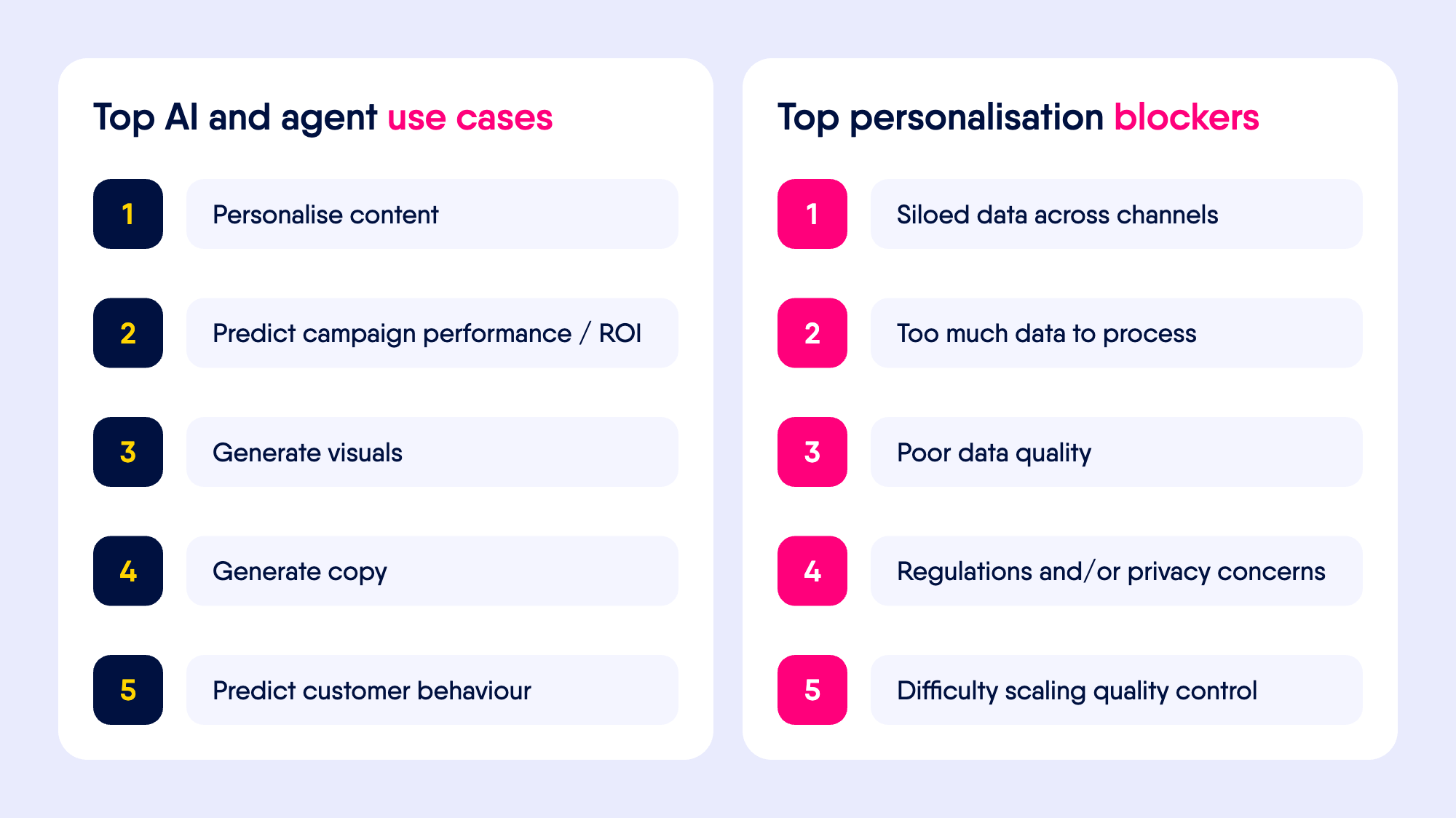
These are closely connected problems.
A general AI tool needs relatively little context to generate a piece of copy. Ask it why a particular audience is disengaging or what you should change in a customer journey and the situation changes.
Now the AI needs to understand what is happening inside your business.
Salesforce’s findings reinforce this. High-performing marketers are 2.4 times more likely to have unified their data sources. Teams satisfied with their unified customer data are also 60% more likely to use AI agents to help scale their work.
Better AI depends on better context.
This is where Saai comes in
Saai was designed around this exact challenge.
Because she sits inside Solitics, Saai works with the structure of each customer’s actual environment. A marketer does not need to export information into another tool or explain their entire setup before asking a question.
That makes the conversation much more useful.
You might ask Saai why a certain cohort is behaving differently. She can analyse the relevant data and help investigate the cause. From there, you could ask her to visualise the result or help decide what to do next.
And because Saai operates directly inside the Solitics platform, the conversation does not have to stop at an answer.
She can help turn an idea into a campaign using the data already available in the customer’s setup. That shortens the distance between understanding something and acting on it.
Saai also comes in industry-specific versions. The iGaming version, for example, is trained around a different set of marketing challenges and customer behaviours than the versions built for Online Trading and Retail Banking.
So the context is not limited to knowing the data. Saai is also trained on hundreds of real use cases and understands the type of marketing work the team is trying to do.
Context changes what AI can do
The value of Saai comes from where she sits.
Saai is built into Solitics, where customer data is already connected and available for real-time engagement. So when a marketer asks a question, Saai is working with the same environment they use to understand customers and run their marketing.
That makes several of the blockers in Salesforce’s research much less limiting.

‘Too much data to process’ looks different when you can ask Saai a direct business question and have her analyse the relevant data for you.
Siloed information is less of a problem when the AI is working on top of a platform designed to bring customer data together and make it usable.
And marketers do not have to spend every interaction giving the AI the context of their business before it can help.
That foundation is a big part of what makes Saai different. She is not being added alongside the marketing operation. She is being built into it.
What’s next for Saai?
Salesforce found that 81% of marketers would trust AI to respond to customers to help scale their efforts, while many remain held back by disjointed or irrelevant data.
That tells us something important about where marketing AI is heading.
Saai already helps marketers analyse performance, work through strategy and build campaigns using natural language. But this is only part of where we see her role going.
The next step is for AI to take on more of the work around the decisions marketers already make. If it understands what is happening and can help act on it, marketers spend less time piecing everything together by hand.
That is a big part of what we have been building into Saai.
We are not ready to reveal all of it here, but we will be showing exactly what that means in a live webinar on 15 October.
You can save your spot here.
Salesforce’s research makes the need behind this direction unusually clear. AI is becoming widely available. The harder problem is building AI with enough context to be genuinely useful inside the business.
That is the problem Saai was built to address.